
Valeri Kubasov
Valeri Nikolayevich Kubasov was a Soviet and Russian engineer-cosmonaut whose career connected spacecraft design, early Soyuz operations, Apollo-Soyuz cooperation, and later Soviet space-station work. Born in Vyazniki, Russia, he graduated from the Moscow Aviation Institute in 1958 and went to work in the design bureau associated with Sergei Korolev. Before he flew in space, Kubasov worked as an engineer on spacecraft systems and trajectory studies, giving his cosmonaut career a technical foundation that was different from the military-pilot path followed by many early space travelers.
- Born
- January 7, 1935
- Died
- February 19, 2014
- Birthplace
- Vyazniki,Russia
Flights
3
Spacewalks
N/A
EVA time
N/A
In space
18 days, 17 hours, 59 minutes
Bio
Kubasov was selected as a civilian specialist cosmonaut in 1966. His first spaceflight was Soyuz 6 in October 1969, flown with Georgy Shonin during a three-spacecraft Soviet mission involving Soyuz 6, Soyuz 7, and Soyuz 8. The objectives did not fully succeed, but Soyuz 6 became historically important for its orbital welding experiments. Kubasov helped conduct work with the Vulcan furnace, testing whether metal joining and cutting could be performed in space. That mission made him part of the technical experimentation that shaped later thinking about construction, repair, and industrial work in orbit.
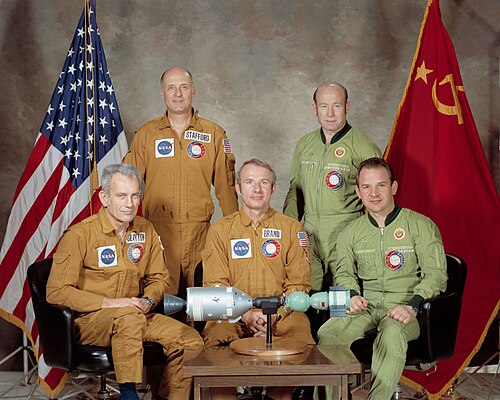
His second mission was Soyuz 19 / Apollo-Soyuz Test Project in July 1975. Kubasov served as with Alexey Leonov on the Soviet crew while Thomas Stafford, Vance Brand, and Deke Slayton flew the American Apollo spacecraft. The mission docked the two spacecraft in orbit, tested international docking procedures, and produced the famous United States-Soviet handshake in space. For Kubasov, it was not a separate third mission from Soyuz 19; Soyuz 19 was the Soviet spacecraft name, while Apollo-Soyuz Test Project was the joint mission name used in English.
Kubasov returned to space in 1980 as Commander of Soyuz 36, flying with Hungarian cosmonaut Bertalan Farkas to the Salyut 6 as part of the Interkosmos program. That flight made Farkas the first Hungarian citizen in space and showed Kubasov in a different role: not only as a technical specialist, but as the commander responsible for an international research crew. Across his three flights, he accumulated 18 days, 17 hours, and 59 minutes in space.
Kubasov's background fit the broader pattern of engineer-cosmonauts whose importance was not limited to flight time. His formal education included Moscow Aviation Institute engineering training, and his professional record included spacecraft design work, cosmonaut training, and later leadership at RKK Energia. His personal record also sits alongside a family life recorded as married to Lyudmila Kurovskaya, with two children, Ekaterina and Dmitry.