
Donald Kent Slayton
Donald "Deke" Slayton was a World War II pilot, test pilot, Mercury astronaut, and one of the most influential crew assignment leaders in NASA history. Born in Wisconsin, he flew combat missions in Europe and over Japan before studying aeronautical engineering at the University of Minnesota. He became a test pilot and was chosen as one of the original Mercury Seven astronauts in 1959.
- Born
- March 1, 1924
- Died
- June 13, 1993
- Birthplace
- Sparta, Wisconsin,United States
Flights
1
Spacewalks
0
EVA time
N/A
In space
9 days, 1 hour, 28 minutes
Bio
Slayton was assigned to fly Mercury-Atlas 7, but an irregular heart rhythm grounded him before the mission. Instead of leaving the program, he became a central figure in astronaut office leadership. As NASA's first Chief of the Astronaut Office and later Director of Flight Crew Operations, he played a major role in selecting and assigning crews throughout Gemini and Apollo. Many of the people who flew to the Moon did so through a system Slayton helped shape.
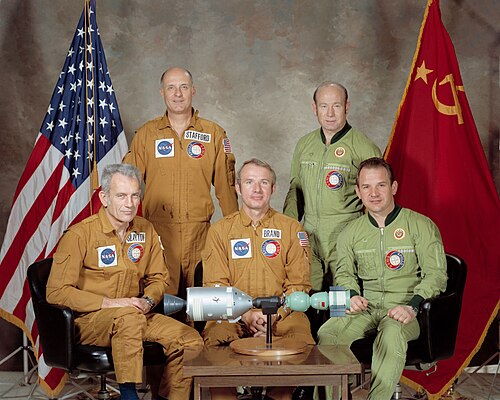
After years of medical review, Slayton was restored to flight status and finally reached space in 1975 as Docking Module Pilot on the Apollo-Soyuz Test Project. The mission joined American and Soviet spacecraft in orbit during the Cold War and gave Slayton the flight he had waited more than a decade to make. His career is as important for the astronauts he sent into space as for the mission he eventually flew himself.
Slayton's background fit the broader pattern of the early astronaut corps: technical training, operational discipline, and a career built around difficult work before spaceflight. His formal education included University of Minnesota (B.S. Aeronautical Engineering, 1949). His service background is recorded as Major, United States Air Force Reserve. His personal record also sits alongside a family life recorded as two marriages, one child, a reminder that these careers unfolded within ordinary lives as well as national history.
Slayton's flown space career centered on Apollo-Soyuz Test Project, where he served as Docking Module Pilot. First joint crewed space mission between the United States and the Soviet Union. The Apollo and Soyuz spacecraft docked in orbit in July 1975, producing the symbolic handshake in space and testing international docking procedures.